- Posts for family history friday tag
52 Ancestors, Week 3: Favorite Photo

This is another post for 52 Ancestors in 52 Weeks where you’ll recognize what I’m talking about if you’ve been here in the past. My favorite photo is the one that really started my genealogy journey, the July 4th picnic in Middleborough, Massachusetts between the Blake and Vaughan families.
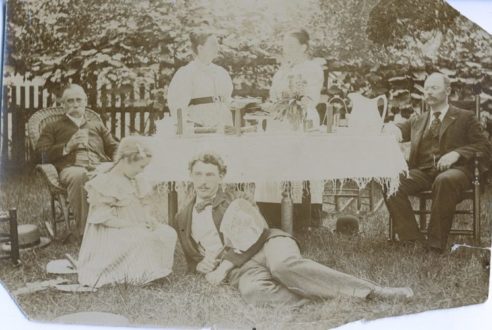
Blake Family Picnic | Our Prairie Nest

The people in this photograph are my great-grandmother, Nina Blake, crouching on the ground, and Sylvanus Franklin Vaughan, lounging next to her with a fan. Sitting on the left is “Pa Vaughan” and “Ma Vaughan” is standing to his right. The woman next to her is my great-great grandmother, Ada Estella Gay, and the man sitting on the right is my great-great grandfather, Edward Henry Blake.

I don’t know what year it was, but it would have to be 1896, because “Pa Vaughan” passed away 17 June 1897. That would make my great-grandmother 4-years-old, about to turn 5 in a few days, which is younger than I first guessed her age in this picture.

I think my great-grandmother looks so pretty here, and I love everything about this photograph. I’ve had it on display in my house for many years. When I first saw it, I was about 12-years-old and my grandmother showed me a crumbling old leather wallet full of Blake family documents. She let me keep the wallet when I was an adult, and the documents in it helped me begin my genealogical journey in earnest, starting with the Blake family.

“Pa Vaughan” and “Ma Vaughan” are Sylvanus H. Vaughan and Eleanor Rodman Walker. The man on the ground is their son, Sylvanus Franklin Vaughan, who would be 19 going on 20-years-old in this photo, since he was born 23 August 1876 in Middleborough. The elder Sylvanus died in 1897, as I mentioned, and was born about 1827. Eleanor was born 11 July 1853 in Boston and passed away 16 June 1909 in Middleborough. The younger Sylvanus eventually became Nina’s brother-in-law when he married Bessie Bartlett Shaw on 19 June 1899.

My great-great grandmother, Ada Estella (Gay) Blake was born 21 April 1861 in Thompson, Connecticut. Edward Henry Blake was born 2 August 1856 in Wrentham, Massachusetts, though for some reason I have never been able to locate a birth record for him. It’s one of those things I’ve always wondered, if his birth was simply never reported, or if there was something else happening there, such as an NPE. However, our Blake lineage is confirmed with DNA.

Ada and Edward were married 20 October 1890 in Southbridge, Massachusetts, and had two children – Nina on 10 July 1891 and Edwin on 20 October 1900. Nina married Harrison Clifford Shaw on 28 January 1912, thus making her Sylvanus Franklin Vaughan’s sister-in-law.

The entire aesthetic of this photo is just lovely. The adults are a little too “posed” and formal in it, but I like how Nina and Sylvanus are on the ground, she looking demure and he looking relaxed. I’m sure 4-year-old Nina would rather be running around on a summer day like this one, but this picture reminds me of my own adorable daughter and some of the attitudes I’ve managed to photograph her in when we least expected it. The July 4th picnic will always have a special place in my heart.
52 Ancestors in 52 Weeks: Favorite Find | Our Prairie Nest
52 Ancestors, Week 2: Favorite Find

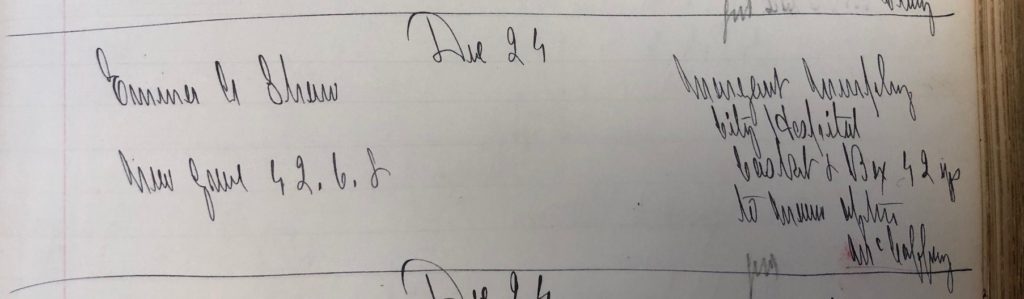
If you’ve visited my blog in the past, you already know my favorite find. It was a receipt for the purchase of a burial site, and it broke my 26-year brick wall wide open!

Ever since I was 18, I’d been trying to find the place and date of birth of my great-great grandmother, Emma Anna Murphy, wife of Erastus Bartlett Shaw. All the records we had, from her 1888 marriage to my great-great grandfather to her 1945 death certificate and obituary, offered conflicting ages and places, from Nova Scotia to Maine to Massachusetts. I couldn’t find her in the 1870 or 1880 U.S. Censuses, or the 1881 Canadian Census. A fellow geneablogger provided me with the 1871 Canadian Census for Manchester, Guysborough, Nova Scotia listing an Emma Murphy. She was the right age to fit, but how could I possibly be sure she was the correct person?

After several years of flailing in every direction, I finally got a hit on a person who appeared to share the same parents – a Margaret Murphy who had died in Boston in 1890. Some more digging also gave me a Margaret Murphy the right age in Manchester, Guysborough, Nova Scotia to be the one who died in Boston. But I was stuck again, not sure where to look.

It was time for another set of eyes to review my research and give me some direction. I booked a consultation with a genealogist at the New England Historic Genealogical Society and was scheduled for a call with Melanie McComb. Prior to the call, she reviewed my timeline and analyzed the records I’d already located. During the call, she went over her recommendations and followed-up by sending me a detailed list of the work she’d done, and where she suggested I go to follow up.

I returned to Margaret Murphy and Melanie’s suggestions for her: follow up on her burial and any probate that might have been filed for her. The death register in Boston didn’t list a place of burial, but the Undertaker’s Return did – Calvary Cemetery in Boston. I emailed a request to the Catholic Cemetery Association and, two days before my birthday in December of 2019, received the best birthday gift a 45-year-old genealogist could want: proof that Emma Anna Murphy had a connection with Margaret Murphy.

52 Ancestors in 52 Weeks: Favorite Find | Our Prairie Nest
Receipt for the purchase of a plot in Calvary Cemetery, Boston, by Emma A. Shaw for Margaret Murphy.

When I received the receipt, I couldn’t contain my excitement. I even woke my poor husband up from a sound sleep by squealing with excitement and shaking him. How could I not?

That one little handwritten slip of paper then led me to pursue Margaret Murphy’s probate file, which turned out to be the genealogical smoking gun that proved Emma Anna Murphy was, indeed, the Emma Murphy found in Manchester, Guysborough, Nova Scotia. Twenty-six years after I’d begun my genealogical journey, my most troublesome brick wall came tumbling down because of this find.

52 Ancestors: Foundations | Our Prairie Nest
52 Ancestors, Week 1: Foundations

This month’s theme for 52 Ancestors in 52 Weeks is “Foundations” and so is this week’s prompt. I’d like to talk about shaken foundations, when you find out the answer to a question isn’t at all what you expected.

Thanks to the wonders of DNA and genetic genealogy, my sense of self – of what I thought I knew about my family – was turned somewhat upside down. Certainly not to the extent that it is for someone who finds an unexpected parent, child, or sibling, but I have some idea of how that must feel.

This happened at the great-grandparent level for me, when my mother and I learned that her father’s father was neither of the men we expected. It was so strange to come to terms with the fact that we had to essentially replace an entire branch of our genetic tree. Why?

Haley Ancestry

For over twenty years, I’d been fascinated by my mom’s paternal lineage. Her father was, as far as we knew, a Haley. These Haleys in Plympton and Middleborough, Massachusetts descended from Edward Marshall Haley, who came from Ireland and settled in Plympton, Massachusetts by 1830. Now that I know better and have been following up on my genetic tree, his name looks strange to me. But for most of my adulthood, he was a man whose life I was trying to follow back to Ireland.

Along came DNA testing, which I embraced whole heartedly starting in 2006 (and still recommend!). And, with it, came a strange new network of genetic relatives I didn’t recognize. The pieces didn’t fall into place until I took DNA tests at every company (23andMe, Ancestry, Family Tree DNA, Living DNA, and MyHeritage) and analyzed my results, as well as my mother’s and maternal uncle’s results.

As it turned out, my maternal grandfather was not a Haley. Not even close. Not one drop of Irish ethnicity and no Haley or related matches to be found. We looked at the other logical option – that he might actually be the son of his mother’s first husband, Joseph William St. Onge, a man whose parents were French Canadian.

Also, no. Not a chance. No matches connected to this prolific family.

Instead, the father was a man we’d never heard of, a man from a tiny town in southern Italy. A man who born in Campora, Salerno, Campania, Italy, who had emigrated from to Boston with his parents and siblings.

Feola Family

My mom and I discussed this finding with a mixture of awe and shock and excitement. DNA answered a question she had asked herself for years: “Was my father’s father really Herbert Benjamin Haley, Sr. or was it Joseph William St. Onge?”

My grandfather’s birth certificate lists his name as “Herbert Haley St. Onge” and his father as Joseph, because that’s who his mother was married to at the time. However, the story we were always told was that Joseph had run off by that time – actually, before Herbert’s most recent half-sibling had been more in 1925 – and that Herbert’s father, Herbert Sr., had come in and helped his mother put her life back together. Naturally, my mother had questioned her father’s paternity for a long time.

But when DNA disproved any possible relationship to the Haley or St. Onge families, we were stunned. Instead, we had to turn our attention to a man named Pasquale Feola, who had been in the right place at the right time to be Herbert’s father.

We didn’t know if he ever had an ongoing relationship with Herbert’s mother. We will probably never know. But, even with the network of Feola and related DNA matches, some of whom were as close as half first cousins, we still held onto the idea that maybe, just maybe, there was a Haley in there somewhere*. Until, that is, one of my grandfather’s nieces through his youngest sister – also supposed to be a daughter of Herbert Haley, Sr. – tested.

The niece was a half match, and we knew that the man we were told had helped my great-grandmother get her life back together – the man whose parents and siblings helped raise my grandfather – may have been his dad, may have given Herbert a name and a real family, but he wasn’t his biological father.

*And I know our Feola first cousins also were surprised to learn that their grandfather hadn’t been perfectly faithful to his wife, and that he – and some of his children, as more DNA testing later revealed – had unexpected children out there.

Family Tree vs. Genetic Tree

I think that distinction explains it best. We have our family tree and then we have our genetic tree. For my mom and I, discovering our genetic tree was a source of excitement. However, it also forced us to rethink what we knew about our family. In the end, we know that the Haleys were truly family to her father. But the truth about the genetics is now out and we are okay with that, too.

This discovery has allowed us to build a new foundation, one that integrates more footings and anchor bolts to keep the concrete slab firmly in place, so we can build something even more intricate on it.

Wallace Family of Nova Scotia | Our Prairie Nest
The Wallace family of Halifax, Nova Scotia

In confirming my great-great grandmother’s paternity, I found myself digging deeper into her father’s family. It’s time to meet the Wallace family of Halifax, Nova Scotia.

Emma’s father was Francis Wallace. It seems more and more likely that he didn’t marry Emma’s mother, Eliza (Elizabeth) Murphy. Francis was the son of James Wallace and Rebecca Elizabeth Smith. He is found in Hutchinson’s Nova Scotia directory for 1866-67 in Port Mulgrave as “Wallace, France – clerk.” He died 16 February 1892 in Boston, Suffolk County, Massachusetts, United States. His probate was administered publicly, and the file doesn’t mention any property or relatives.

Francis came from a family that seemed otherwise respectable and well-to-do in Halifax. One story that Emma passed down to her grandchildren was that her family “owned ships.” That’s certainly possible, however the paper trail and DNA evidence that have led us to the Wallace family tell a slightly different story.

Francis’ brother, Vincent Wallace, was a customs agent in Halifax, Nova Scotia. He didn’t own ships, but he was tied to the shipping industry by his work. Vincent was born 19 Jul 1835 in Halifax and died rather young on 27 November 1878 in Port Mulgrave, Guysborough, Nova Scotia, Canada. He and his wife, Margaret Mahoney (m. 3 Feb 1864 in Guysborough) had 3 children: Clara E. (b 1865), Howard Sylvester (b. 6 Oct 1866), and Eugenie (b. Jan 1864, m. 2 Jun 1897 to John S. McDonald in Halifax, witnessed by Catherine Wallace).

Descendants from Vincent are among mine and my father’s DNA matches. Francis had other siblings as well, and I don’t know yet if they were tied to the shipping industry, or what his father did for a living. This is a family I’m still newly researching and I hope to learn more about them.

Finding NPEs among my family – first for my maternal grandfather’s father and then for Emma (my father’s great-grandmother) – has changed much of what I learned about my family tree when I was a teenager. As always, traditional, paper trail research is the best way to start. Genetic genealogy can provide confirmation or a different/unexpected path to research, and works well to enhance what you already know… or to lead you elsewhere!

Enslaved People in my Family History | Our Prairie Nest
Enslaved People in my Family History

Some of my ancestors fall under the definition of enslavers. Not all of them and not only the southern ones, either. Many people think slavery was endemic only to the southern United States, as far as U.S. history, but that’s not correct. There were enslaved people in the northern states, and I found at least one in my family in the federal census in Rhode Island. At the time, I didn’t pay as much attention as I do now, but I never forgot the surprise of seeing a tick mark in the box indicating my family had an enslaved person.

When I discovered my southern ancestors and found documents naming the people they kept enslaved, I decided to explore further and look into the names and histories of these people. Some people don’t understand why I would do that, let alone care. Maybe some people find it distasteful to address these aspects of our country’s history. Others, I know, say they would never admit to having ancestors who were enslavers. However, I think it’s important to address this, because it’s a fact of my family history. Rather than bury our heads in the sand, we need to say this was wrong and amoral, and learn from history.

However, the main reason I choose to talk or write about this is also because the enslaved people were people. They had their own personalities, thoughts, feelings, and hopes. Being enslaved is not and should not be all that defines them. So I would like to talk about the enslaved people in my family history. Furthermore, I would like to learn more about each and every one of them, if at all possible. Did they go on to have descendants? What were their experiences? What were their descendants’ experiences? Do they have living descendants today who are aware of their ancestors’ past as enslaved people? What are their thoughts and feelings about their ancestors’ experiences?

The Enslaved People

My nearest ancestor I can pinpoint as keeping enslaved people in his home is my 5th great-grandfather, Richard Howett, born about 1755 and died between 13 May 1805 (date of his Will) and 8 Feb 1806 (date his Will was probated) in Tyrrell County, North Carolina. His Will was the first document I ever found that named people who had been enslaved and also a sobering reality check. These people truly were treated as things, bequeathed in a Will with all other belongings, as if they were nothing more than livestock or furniture. Here are excerpts from Richard’s Will referring specifically to enslaved people:

I give unto my well beloved wife Lydia Howett one negro woman called Genea… I also lend the use of the following negroes one negro woman called Chloe one negro by called Washington on conditions that my wife raises the increase of these two negro women lent during her life, also I lend to my wife one negro man called Squire during her natural life… I leave to my son Richad Howett one still it is my will and desire that negro woman Tamer and negro woman Silve be sold by my executors at six months credit to the highest bidder at public auction the purchaser giving bond with good security and the money arising from said sail shall be equally divided between Charlotte Windsor and Patsey Windsor as their full share of my estate, I give my son Silvenus Howett a negro boy called Washington that I have lent to my wife at her death…

In addition to Richard’s Will, the fourth document in his probate file shows that Joshua Skinner filed a petition in 1822 for the sale and division of negroes, stating Lydia, Richard’s wife, did not adhere to the terms of the Will, to “raise the increase” of the negro women Chloe (Cloe) and Moll. Chloe had 4 children: Nancy, Mary, Samuel and Patience, and the petition asked that they be sold and the funds divided among the Howett heirs entitled to them.

Another document from 1821 shows the following enslaved people sold as part of the estate (their ages were listed in the document, and I added estimated dates of birth): Jim (23 – b. 1798), Aggy (20 – b. 1801), Jimmy (5 – b. 1816), Cooper (3 – b. 1818) (Jimmy and Cooper were Aggy’s sons), and Mariah (15 – b. 1806). Others named in the estate were a boy, Spinner/Spencer, and an old woman, Doll (or possibly Moll).

Seeing the actual document with your own eyes is very different than seeing it typed out, but no matter how we come across such records, acknowledging our history is important. Even more important is not letting the history of these people end up buried and forgotten. My ancestors enslaved them, but I promise to honor their lives.

Southern Italian Ancestors | Our Prairie Nest
Southern Italian Ancestors

Once upon a time, my father joked, “Why do you talk with your hands so much? What are you – Italian?” Being about 16 and not know any better, I shot back, “Maybe I am!”

Two years later, when I delved into genealogy in earnest, I learned the truth. Or half of it.

My mother’s mother’s family is Italian, from the Piedmont and Liguria regions of Italy. I’ve researched them for the past thirty years and learned a great deal about them recently thanks to Family Search and the Antenati website.

What no one knew thirty (and more) years ago was that my mother’s father was also Italian. Looking at him now, it’s pretty obvious that he looks nothing like the redheaded Irish man we were always told was his father. Grandpa’s mother had seven children, and we knew there were three different fathers among them. And then came DNA testing and the surprise that there was a fourth father!

At first, we thought DNA testing would confirm that either the man we’d always been told was grandpa’s father or the man who was my great-grandmother’s first husband was my grandpa’s father. The network of Italian matches connected to me, my mother, and my uncle, but not my nana, proved otherwise.

It was a close family member match that sealed the deal as far as determining my grandfather’s lineage. While close Y-DNA matches haven’t yet popped up yet, we had enough half first cousin matches to confirm my grandfather’s paternity.

The Feola Family

Where my nana’s mother was from northern Italy, my grandpa’s father was from southern Italy. His surname was Feola and his family came from Campora, Salerno, Campania, Italy. I have an enormous number of matches from this family. In fact, I think they are my largest genetic network. Campora suffered a genetic bottleneck in the 1700s, and the centuries of intermarriage are quite apparent as I work on a separate quick and dirty family tree to connect these matches, and then verify the lineages to add them to my tree.

Nearly all the surnames I find – Feola, Tomeo, Carone, Calabria, Perriello, Trotta, Vitale, Veltri, and others – recur frequently. On the one hand, it makes it easier to build and then verify the tree. On the other hand, the pedigree collapse means I can only guess at which ancestral couples passed on the DNA my matches and I share. I list that potential couple in my spreadsheet and notes, but also add “and possibly others.”

As far as my grandfather, it all starts with one of the sons of Antonio Michele Feola (born 8 December 1864 in Campora, and died after 1910, probably in Scituate, Plymouth, Massachusetts) and Alessandrina Beatrice Tomeo (per their marriage record, 18 April 1887 in Campora; she was born May of 1864 in Campora and died 21 May 1909 in Scituate, Plymouth, Massachusetts). I won’t say which son, because he has living grandchildren from his marriage to his wife, and it was certainly a surprise for them to find out they had half first cousins (my mother and her siblings). However, he is named in my family tree.

Antonio, or Anthony, was the son of Giovanni Feola and Teresa Sofia. Alessandrina was the daughter of Nicola Tomeo and Francesca Maria Trotta. I’ve been able to confirm a few generations with vital records, something I’m doing slowly and steadily, since I’m not focused on researching this part of my family at this time.

It’s still taking time to get used to the fact that these are my ancestors. However, there’s no doubt about it. The DNA has spoken! While I’m devoting far more interest and attention to my northern Italian ancestors, I think if I ever visit Italy, a trip to Campora would certainly be part of that.